Saturday, January 1, 2011

Great Show at the Frist Center in Nashville

The Frist Center is just going from strength to strength.  Each show that I see there seems better than the last.  Right now, there's a show there called The Birth of Impressionism, with paintings from the Musee d'Orsay in Paris.

Some of these paintings are familiar, like Manet's The Fife Player:

And "Whistler's Mother," which is really called Arrangement in Gray and Black No. 1, or The Artist's Mother, 1871:


One important thing to notice in both these canonical paintings is how there are large areas of basically flat, relatively unmodelled shapes.  When you take an art history course, you learn that this was a new thing in mid to late 19th century painting, especially in Manet.  Apparently French painters were inspired by Japanese woodblock prints, which had large flat unmodelled areas.  But this show makes this innovation really jump out at you, because the first room is full of Salon-style paintings, which were highly modelled and much more "realistic," except for the fact that they included so many winged cherubs and mermen, and the fact that none of the women have any body hair except on their heads (Ok, maybe not so realistic, but realistically modelled.)


Impressionist painters and (big R) Realist painters like Courbet were reacting against the silliness of these paintings of mythological subjects.  They preferred portraying peasants and ordinary people, like the exhausted haymakers below:


These two paintings, though worlds apart conceptually and thematically, are both equally huge.  So painters like LePage, who painted the haymaking scene, were stating that ordinary people were as heroic in their own way as the gods and goddesses of mythology.  Some of the paintings of peasants at work remind the viewer of Soviet realism, with its  idealized portraits of muscular peasant women.

I have always been sort of ashamed of the fact that English and American painting could never rival that of France in the 19th century, and well into the 20th century.  But a wall plaque in this show pointed to the influence of Constable on French landscape painters, particularly on the Barbizon school, the members of which painted in a forest near Paris.  But Renoir ventured further afield, to Algiers:


This kind of painting--devoid of narrative, a "painting of nothing"--drove the academicians and traditional painters in Paris crazy.  But you can see what it owes to Constable's
Dedham Vale, painted in 1801, eighty years earlier:

  But the Impressionists of the late 19th century had an advantage over Constable, namely, new colors!  When you enter the room with the Algerian painting, everything suddenly lightens and brightens up.  The colors are fresher and clearer, fewer shades and more tints, and the tints are very pure hues.  This is due to the presence of colors like viridian (a clear green), aureolin (yellow), cerulean blue (a greenish blue) and a new, cheaper synthetic ultramarine blue.  These are colors that I've taken for granted my whole painting life, but they were brand new toys for the Impressionists.

Another advantage for the Impressionists over their mentor Constable:  paint in tubes.  Constable had to mix his own paints and store them in little skin containers.  But Renoir could carry his colors outside in tubes, as we do today.

There are many more interesting things to look for in this show, such as the influence of photography on the way painters cropped their paintings; the appearance of "art within art," as in the painting of Whistler's mother; and the effect of the disastrous Franco-Prussian war on the nascent modernism of French painting.  We in Middle Tennessee are lucky to be able to see these paintings from the Musee d'Orsay in Nashville.

Tuesday, October 12, 2010

More pictures of Marfa

Tom also made a lot of photographs in Marfa, with his new digital SLR.  Here are some of them.

 This is Building 98, where the show of photographs about the Adobe Alliance is for the next three weeks.


 Building 98 has an interesting history.  It was the Bachelor Officer's Quarters for an army unit in the thirties and forties.  During WWII, some German prisoners of war were kept here, and they painted some murals about West Texas on the walls inside.

It's interesting to imagine how surprising the landscape of West Texas must have been to the average guy from, say, Bavaria.


 Below is a picture of Mona Garcia, the gallerist, and a board member of the International Woman's Foundation:


Here is the Arcon Inn, the bed and breakfast where we stayed, also owned by Mona Garcia:


It's conveniently located near the center of town, right behind the courthouse.  Speaking of which:


Monday, October 11, 2010

Trip to Marfa

Tom and I just returned from a trip to Marfa, TX. Our main purpose was to install an exhibition of my photographs about the Adobe Alliance and Simone Swan at Building 98, near the Chinati Foundation.  Building 98 is a gallery run by Mona Garcia.

Here are some pictures of the pictures:


This last one shows the group at the Adobe Alliance workshop in the spring of 2010.

It was Chinati Weekend in Marfa, and there was a lot to see and do.  We made the rounds of the galleries.  I was really impressed by the work of Claire Oswalt at Galleri Urbane.  She does wonderfully detailed graphite drawings, some of them quite small.  The tree picture is maybe 5x7 inches, and the head portion of the portrait is maybe an inch and a half!

The other thing to look at in Marfa, besides all the art, is just the wonderful light that bathes and beautifies everything in the town and on the streets, and also the wonderful spaces outside of town.  I found a footpath through a scrubby desert pasture, with a sign saying that people were allowed to walk there, so I did.


We also went to a football game, where the Marfa Shorthorns demolished the visiting team.  The band played "Ghost Riders in the Sky" and "Deep in the Heart of Texas."  Some of the football players did double duty, playing for their school on the field, and playing in the band at half time.  People who live in small towns have to be multi-talented and play many roles, in order for everything to get done that needs to get done.  No One-Dimensional Men or women in Marfa!

Wednesday, June 30, 2010

Chihuly in Nashville

Tom and I went to see the Dale Chihuly shows both at Cheekwood and at the Frist in Nashville.  We thought that the big, organic form glass pieces looked better outside in the landscape than in captivity inside the old post office.  Still, wherever you see them, they are amazing.  Tom called them "eye candy," and he meant that in a good way.

We weren't allowed to photograph inside the Frist Center, so all the photographs here are from the Cheekwood show.  First you go in the Botanic Hall, and you see the "Macchia."  Like most of Chihuly's work, the Macchiae seem to be abstractions of some sort of organic form, maybe a sea creature of some kind.  I have always loved the tropical plants in the atrium in the Botanic Hall, which themselves have amazing forms, so these glass plants or sea creatures seemed right at home there.


Later Tom pointed out that these "cups" couldn't be outside or they would accumulate water, and maybe even breed mosquitoes.  True.

Next you go behind the Botanic Hall and you see a tall "Saffron Tower," which probably looks better lit up at night.  (Cheekwood is open on Thursdays and Fridays at night, when all the glass is lit up.  I'm planning to go back and see it at night sometime.)  Next to the tower are the "Cattails," which look perfect in their garden setting.  Whoever sited them paid close attention to color harmonies.

I love the way the orange complements the purple foliage below.


After the cattails, you walk down an allee, and you see in the distance some blue pointy things that turn out to be more pieces in Chihuly's "Fiori" series.  I think "fiori" means flowers in Italian.  Chihuly studied glass-blowing in Venice, where glass-blowing reached a peak in the early Renaissance.


Up close, the blue and green spikes look like this:

Again, the color coordination is very good:


It's fortunate that Cheekwood has a Japanese garden, because Chihuly has some pieces that have a Japanese theme.  "Niijima Floats" is based on fishing floats used in Japan.


Sadly, you are not allowed to walk around in the Japanese gardens and get up close to the "floats."  You can look at them from a Japanese-style pavilion, though.

There are also "Bamboo Reeds" among the real bamboo, which I particularly liked, being aficianado of bamboo and a prolific grower of bamboo myself.  Bamboo forms are among the most subtle and beautiful of the plant world.

Then you progress to the three large koi ponds at Cheekwood.  Well, at least, when I was a little girl there were huge koi in these pools.  I seem to remember that we had to release one of our own overgrown goldfish into one of these ponds once.  Anyway, this summer they are home to an installation called "Walla Wallas," named after the onions from Chihuly's home state of Washington.  But these are onions that float.


Above the waterfall in the upper right, you can see a boat filled with heron-like figures of many colors.

One thing that's great about this show is how kid-friendly it is.  There were a lot of little kids in strollers and on foot running around Cheekwood ooh-ing and ah-ing at the brightly colored objects. Too bad you can't touch!  One little kid even pronounced the biggest piece on the front lawn to be "breath-taking."

Here it is, the piece de resistance, called "The Sun":

To me this piece resembled something you might see at a very ambitious birthday party, where the parents have hired a balloon artist to blow up a lot of balloons and twist them into funny shapes.  But it's glass!  And it's very big.  Chihuly wrote, of the inspiration for this piece:

"If you take a thousand blown pieces of a color, put them together, and then shoot light through them, that's going to be something to look at.  It's mysterious, defying gravity or seemingly out of place--like something you have never seen before."

I like Chihuly's idea that it's ok to make something that's just pure spectacle, pure intense color and light. Color and light are what visual experience is made of.  Why not push that to the limit?  Of course, in this piece, the elements of line and form are also "something to look at."  When I look at visual art, I want it to be "something to look at."  A lot of visual art of the last two or three decades has been more "something to think about," rather than something that's there for pure visual pleasure.  It's refreshing to be handed some pure visual pleasure, almost like a flavor.  "The Sun" looks delicious, like some kind of Dairy Queen extravaganza.  Or again, like a sea creature or tropical plant.  The huge boxwoods in front of Cheekwood (themselves something to look at) were a good foil for this big yellow flower.

Inside the big house, there were more marvels, but we weren't allowed to photograph.  Chihuly made some chandeliers for Cheekwood, and there's one in the spiral stairwell, and three in the glassed-in porch.  I hope they're there to stay.  The Swan Ball will never be the same again (not that I've ever been to it).   There was also a small exhibit of Chihuly's drawings.  Chihuly himself doesn't blow glass any more, due to a shoulder injury.  He works with "gaffers," strong guys who blow and tilt-a-whirl the glass into the shapes that he's drawn.  He works collaboratively with a large team of helpers.  You can see a very interesting film about the process in the courtyard gallery at the Frist Learning Center, next to the big house. (Don't ask me why so many things in Nashville are called The Frist Something or Other.  The same is true at Princeton.)

One thing I liked about the drawings, which were really paintings on paper, was that Chihuly used iridescent watercolor paints.  Go for the gusto!  Don't worry about being tacky!  Just do it!  Now I want to make a bunch of iridescent watercolor paintings. Again, Chihuly's design sense is kind of child-like and playful, uninhibited, in an admirable way.  As Picasso said, "Every child is an artist.  The problem is how to remain an artist when he grows up."  Answer:  use a lot of bright colors and sparkly things.  And then make it really big.

On to the grotto and the shell fountain, over beside the big house, near that spectacular wisteria arbor.  Here we find the blue marlins and yellow herons:


You can see Tom looking down over this scene in this picture:

Since Cheekwood is built on the top of a hill, the gardens around the house are terraced, in a lovely way.  Below this grotto is a reflection pool, and Chihuly placed an installation there called "Mille Fiori," or a thousand flowers.  Chihuly's mother was an avid gardener, and she remains an influence on him.


The way the forms reflect themselves in the water adds to the pleasure of looking at and photographing these pieces.  The many new forms created by the reflections and the sky and the clouds remind me of Monet's water lily paintings.  I really wanted to come back and spend a day at Cheekwood drawing some of the installations.

Walking back to the parking lot, you pass another little pond that DOES have a waterlily in it!

In the background you see the "Blue Polyvitro Crystals."

Finally, there's a piece that is pink, a color not seen in the other pieces.  This glass also has some iridescent colors in it:

It reminded me of Victorian glass Christmas tree ornaments, only really big.

This show is really worth seeing.  Take a child and a picnic, a camera and some Prismacolor pencils and paper, and enjoy the eye candy.

Thursday, April 15, 2010

Andrea Dezso: Houston, We Have an Imagination

The Rice Gallery on the Rice University campus always has interesting installations.  Artists are invited to create installations specifically for the space.  These installations often have a light-hearted, even humorous feel to them, like Wayne White's Big Lectric Fan, which I wrote about in this blog last fall.

Andrea Dezso's wonderful installation, "Sometimes In My Dreams I Fly," is not as laugh-out-loud funny as White's big puppet head of George Jones, with its mouth opening and closing as he snores, but it is still delightful.  Dezso's sensibility is that of the rare adult who has preserved a child-like faith in the importance of imaginary worlds.  Her installation takes the space program as its starting point--appropriate for Houston on the fortieth (!) anniversary of Apollo XIII.  But Dezso grew up in Communist Romania.  The space program that fired her imagination was the Soviet space program.  She collected stamps with images of astronauts and space travel and followed the news of their flights.

In a video on a screen in the foyer, Dezso explains that she thinks the ill-fated Apollo XIII flight ("Houston, we have a problem") was actually interesting mostly because it didn't get to the moon.  She says that even if we don't actually get to go to the moon or into space in our real physical bodies, we can go in our imaginations.

When I was a child, I had a book called You Will Go To the Moon.  It was written in 1959.


It's amazing that in 1959, people really believed that children born in the fifties would someday vacation on the moon, sort of like people in the fifties drove to the Grand Canyon.  Like Apollo XIII, though, I have not gone to the moon and never will.

Dezso's installation is based on her previous series of tunnel books.  A tunnel book is a three-dimensional book that you look into as if looking into a tunnel.  Pages are partially cut away in front to reveal other scenes behind them.


These books are small, perhaps 6"x 8" and about six inches deep.  For the Rice Gallery installation, she imagined tunnel books big enough to walk into!  And then she built them in the gallery space.  You can't actually walk into them:  you look into them through the big glass windows in front of the gallery.


The effect is mysterious and tantalizing:  you can see deep into this "scene," but you can't exactly crawl in there and explore it.  Careful lighting makes the back of the "tunnel book" brighter than the foreground, creating the "repousse" effect of 19th century romantic landscape painting.  Silhouettes of strange creatures are seen prancing and flying against the background colors.


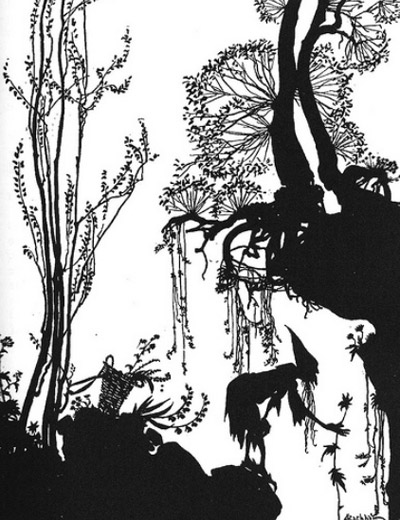
The invented creatures are probably the most interesting part of the show.  Part insect, part animated plants, part astronaut, they fly and swim and crawl, reminding me of Arthur Rackham's silhouette illustrations:


Like Rackham's fairies, Dezso's space plants, insects, and people seem not entirely benign, although they are not exactly monsters.  Carrot Man, for example, has a kind of manic grin.  The average child would not be entirely pleased to meet him.


(Dezso has cut out huge life-size versions of some of her creatures and attached them to the exterior doors of the gallery.  Carrot Man is one of them.)

But who wouldn't want to be a Female Astronaut with a Leaf-Powered Propeller?  As a child, I, like most children, sometimes did dream I could fly, and the cartoon images of the Jetsons flying around with jetpacks on their backs made it seem that maybe I would Go To The Moon, or at least fly around Nashville with my jetpack on.  Apparently Romanian children were having the same dreams and fantasies, as we all cowered under our mutually assured mushroom clouds.  For the space program was the flip side of MAD:  technology's benign side, like Our Friend the Atom.  We all loved Tang and Space Food Sticks, the only discernible benefits of the space program.


And so there are both utopian and dystopian elements in these scenes:  the leaf-powered propeller hints at a time when plants might provide people with some new kind of alternative "green" transport; but at the same time the landscapes are replete with machines and power lines.  However, the machines look more like carnival rides than like gritty industrial rust-belt relics.


The power lines just look like power lines.  That in itself is a little jarring:  in this fantastic world where people have propellers on their heads, they also have these banal power lines or drilling rigs.  It looks like Texas.

Dezso has impressive paper-cutting skills. I'm impressed because I think she must have done most of the cutting with an Exacto knife, and I am trying to get better at using one of those tools.  Paper cutting is hot right now in the world of contemporary art:  there's a show at the Museum of Arts and Design called Slash: Paper Under the Knife. 
Dezso has a tunnel book in that show, and another long-time cutter of paper is also in the show:  Kara Walker, whom I immediately thought of when I first looked at Dezso's show.  Walker's cut paper figures are, of course, much more disturbing, even nightmarish:


Dezso seems to draw on this work, and perhaps that of Arthur Rackham, to evoke a not-quite-benign, but nonetheless tantalizing dream world, in which one might experience flying, if not to the moon, then at least with a leaf propeller on your head.

Thursday, February 18, 2010

Sally Heller, "Ab-Scrap"

Ab-Scrap is an interesting installation at Lawndale, by New Orleans artist Sally Heller.


The title seems to refer to the fact that the installation is a kind of abstract three-dimensional "painting" made with scraps of fabric and jewelry, beads, mirrors, string, and wire.  

You can walk around in the installation, as if it's a kind of landscape.  It even has trees.


The colors, beads, and trees reminded me of New Orleans after Mardi Gras, when you see beads hanging in live oak trees.